Windows don’t fail all at once. They lose efficiency gradually — seals weaken, frames shift, hardware wears down — until the cumulative effect shows up as drafts, condensation, rising energy bills, and rooms that never seem comfortable regardless of what the thermostat says.
In Maryland’s climate, where summers push 90°F with high humidity and winters regularly dip below freezing, your windows work harder than they would in a milder region. That accelerates wear and makes the performance gap between aging windows and modern replacements more significant than homeowners often realize.
Here’s how to know when it’s time, what to look for in replacement windows, and what the process actually involves.
5 Signs Your Windows Need Replacement
Not every window problem requires replacement — some can be repaired. But certain symptoms indicate the window has reached the end of its useful life.
- Drafts and Temperature Inconsistency
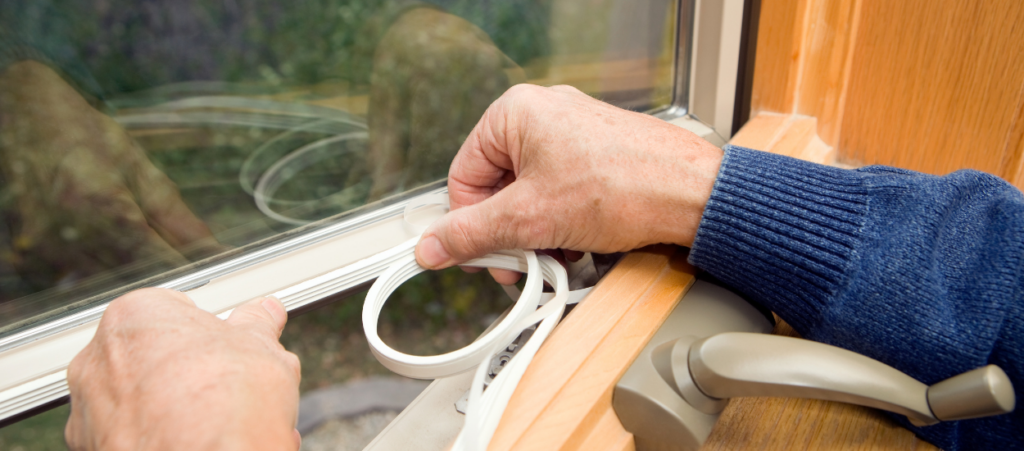
If you feel cold air near closed windows in winter or notice certain rooms are consistently harder to heat or cool, the window’s seal, weatherstripping, or frame may have failed. A single drafty window can often be re-weatherstripped, but if drafts are widespread across multiple windows, the issue is systemic and replacement is the more practical path.
- Condensation Between Glass Panes
Fog or moisture trapped between the panes of a double- or triple-pane window means the insulating gas seal has failed. Once that seal breaks, the window’s insulating performance drops significantly. The glass unit can sometimes be replaced independently of the frame, but in many cases — especially on older windows — full replacement is more cost-effective.
- Difficulty Opening, Closing, or Locking
Windows that stick, won’t stay open, or can’t be locked properly are more than an inconvenience. They’re a security issue and a ventilation issue. The cause is usually frame warping, hardware failure, or balance system deterioration — all of which worsen over time. If multiple windows in the home are affected, the frames have likely reached end of life.
- Visible Rot, Warping, or Water Damage
Wood frames that show soft spots, peeling paint, or visible rot have been compromised by moisture. Vinyl frames that are warped or discolored from UV exposure have lost structural integrity. In either case, the frame can no longer support the glass unit properly or maintain a weather-tight seal.
- Excessive Outside Noise
If traffic, lawn equipment, or neighborhood noise passes through your windows as if they’re barely there, you’re likely dealing with single-pane glass or failed seals on older double-pane units. Modern replacement windows with insulated glass and tight frame construction reduce sound transmission significantly.
How Old Windows Affect Energy Costs in Maryland
Maryland’s climate is demanding on windows. Humid summers mean your cooling system runs for months, and windows that allow heat transfer or air infiltration force it to work harder. Cold, wet winters drive heating costs up for the same reason — and Maryland’s coastal exposure adds wind-driven moisture to the equation.
Single-pane windows — still common in older Annapolis, Severna Park, and Baltimore-area homes — provide almost no insulation. Double-pane windows with failed seals aren’t much better, because the insulating gas layer between the panes is gone.
Modern double-pane replacement windows with low-E glass coatings and argon or krypton gas fill can reduce energy loss by 30–50% compared to single-pane units, according to the U.S. Department of Energy. For homes with many original windows, that translates to a meaningful reduction in heating and cooling costs over the life of the windows.
Understanding Window Efficiency Ratings
Window shopping involves a lot of numbers. Here’s what actually matters when comparing products.
U-Factor
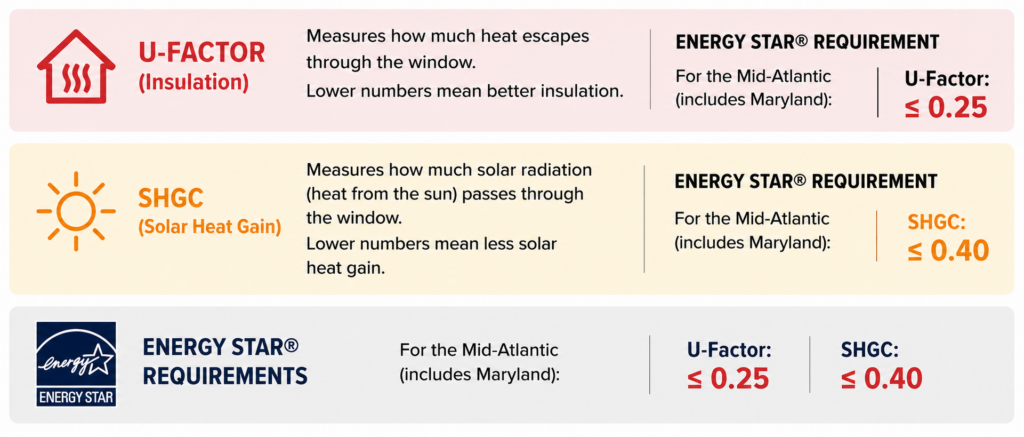
U-factor measures how well a window insulates — specifically, how much heat passes through it. Lower numbers are better. For the Mid-Atlantic climate zone (which includes Maryland), ENERGY STAR requires a U-factor of 0.30 or below.
A U-factor of 0.27 — which is a common question homeowners ask about — meets ENERGY STAR standards and represents solid performance for a vinyl or fiberglass replacement window. Premium products push below 0.25, but the performance gains get incrementally smaller as the number drops. For most Maryland homes, anything at or below 0.30 is a meaningful upgrade over what’s currently installed.
Solar Heat Gain Coefficient (SHGC)
SHGC measures how much solar radiation passes through the glass. Lower numbers mean less heat gain from sunlight. In Maryland, where summer cooling costs are significant, a lower SHGC helps keep interiors cooler. ENERGY STAR requires 0.40 or below for our climate zone.
The trade-off: very low SHGC also reduces passive solar heating in winter. For most Maryland homes, the summer cooling benefit outweighs the winter loss, but south-facing windows may benefit from a slightly higher SHGC to capture winter sun.
ENERGY STAR Certification
ENERGY STAR-certified windows meet minimum performance thresholds for your climate zone. It’s a useful baseline, but it’s a floor, not a ceiling. Many of the windows Fichtner installs exceed ENERGY STAR minimums — particularly ProVia’s vinyl line, which is ENERGY STAR certified across its product range, and Marvin’s fiberglass windows, which deliver strong thermal performance through low-conductivity frame materials.
Choosing the Right Replacement Windows for Your Home
The right window depends on your budget, your home’s architecture, and what you’re trying to solve.
Vinyl frames are the most affordable and lowest-maintenance option. They don’t need painting, resist moisture, and perform well thermally. ProVia’s vinyl windows are a strong choice in this category — they’re crafted in the USA with professional-grade construction and carry solid warranty coverage. For most homeowners looking for reliable performance at a reasonable price, vinyl is the right call.
Fiberglass frames are stronger and more dimensionally stable than vinyl, which means they resist warping in temperature extremes better. They’re slightly more expensive but offer excellent longevity. Marvin’s Elevate collection pairs a durable Ultrex fiberglass exterior with wood interiors and clean finishes — a strong option for homeowners who want the performance of fiberglass with a refined interior look.
Wood and aluminum frames offer the highest level of customization and architectural detail. Marvin’s Ultimate collection provides extensive design customization with aluminum-clad or wood exteriors and custom wood interiors — ideal for historic homes, custom builds, or homeowners who want premium materials and craftsmanship.
Fichtner Home Exteriors is a Marvin Authorized Replacement expert, and our installers are trained by both Marvin and ProVia. We can help you match the right product line to your project during a free consultation.
Window styles also matter. Double-hung windows are the most common in Maryland homes and work well for most applications. Casement windows (crank-operated, hinged at the side) provide better air sealing and are a strong choice for hard-to-reach locations. Picture windows maximize natural light but don’t open. Sliding windows suit wider openings where a double-hung profile doesn’t fit. Browse our windows and doors gallery to see recent installations across Anne Arundel County.
What to Expect During Window Replacement

Window replacement is less disruptive than most homeowners expect.
Most projects use insert replacement — the new window is installed inside the existing frame opening. This is faster, less invasive, and less expensive than full-frame replacement. It works well when the existing frame is structurally sound.
Full-frame replacement removes the entire window assembly, including the frame, and installs a new unit from scratch. This is necessary when the frame is rotted, warped, or damaged, or when you want to change the window size.
Plan to move furniture and window treatments away from the work area, and clear exterior access (landscaping, outdoor furniture) so the crew can work efficiently. Your installer will protect interior flooring and clean up at the end of each day.
Get a Free Window Replacement Estimate
If your windows are drafty, fogged, difficult to operate, or simply old enough that you’re wondering whether it’s time, a professional assessment is the place to start. We’ll evaluate your current windows, discuss what you’re trying to improve, and recommend the product line and approach that fits your home and your budget.
Fichtner Home Exteriors provides free window replacement estimates across Annapolis, Anne Arundel County, Howard County, Baltimore County, and the surrounding communities.
Schedule your free estimate or call us at (410) 519-1900.
FAQs About Window Replacement in Maryland
Yes. A U-factor of 0.27 meets ENERGY STAR requirements for the Mid-Atlantic climate zone, which requires 0.30 or below. It represents solid thermal performance for a vinyl or fiberglass replacement window. Lower is better — premium products push below 0.25 — but 0.27 is a meaningful upgrade over most older windows and a good benchmark when comparing products.
Yes. Professional installers work one window at a time, minimizing the opening’s exposure to cold air to 15–30 minutes per window. The installation materials (caulks, foams, sealants) used by experienced contractors are formulated to perform in cold temperatures. Winter installation is routine — don’t let the season delay a project your home needs.
Cost varies by window size, frame material, glass package, and installation type. Vinyl replacement windows generally fall in the mid-range on a per-window basis, while fiberglass and wood/aluminum options cost more. Factors like custom sizes, multi-story access, and full-frame vs. insert replacement also affect pricing. The best way to get an accurate number is a free in-home or satellite estimate based on your specific windows.
Yes. Double-pane insulated glass reduces sound transmission significantly compared to single-pane windows. For maximum noise reduction, laminated glass or triple-pane configurations provide additional sound dampening. This is especially relevant for Maryland homes near busy roads, flight paths, or in denser neighborhoods.
For same-size, same-location replacement windows, a permit is typically not required in most Maryland jurisdictions, including Anne Arundel County. However, if you’re changing the window size, adding a new opening, or altering the structural framing, a building permit is required. Your contractor should confirm permit requirements for your specific project before work begins.